
• 太阳能发电厂投资分析

    Investment analysis of solar power plant

  • Solar Power Plant vs Traditional Power Plant

    太阳能电站 vs 传统电场

    Background

    背景

    To meet the growing regional electricity demand and optimize the energy matrix, a regional utility company plans to add 100MW of power generation capacity. Management is currently facing two distinctly different technical and financial paths.

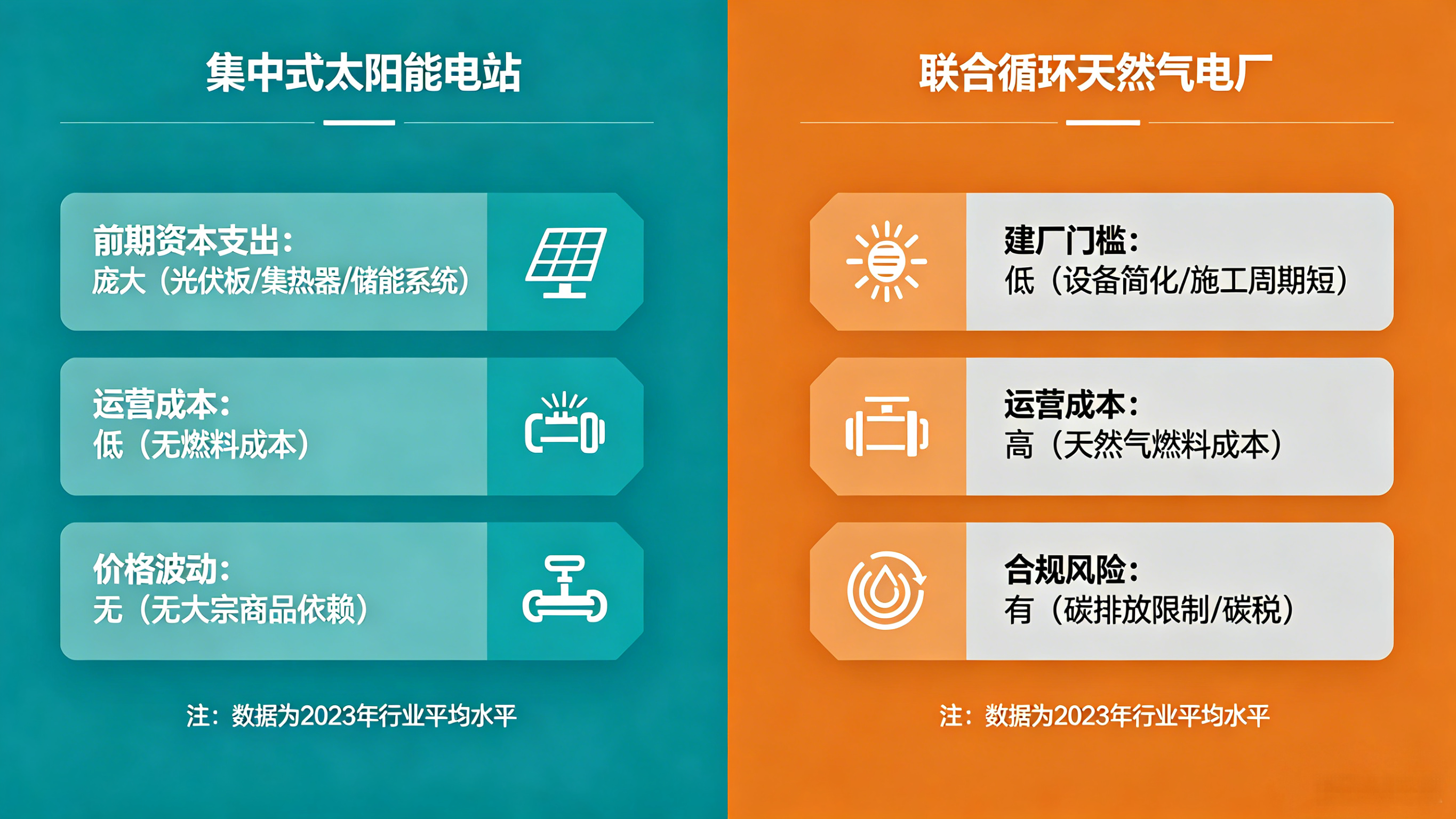
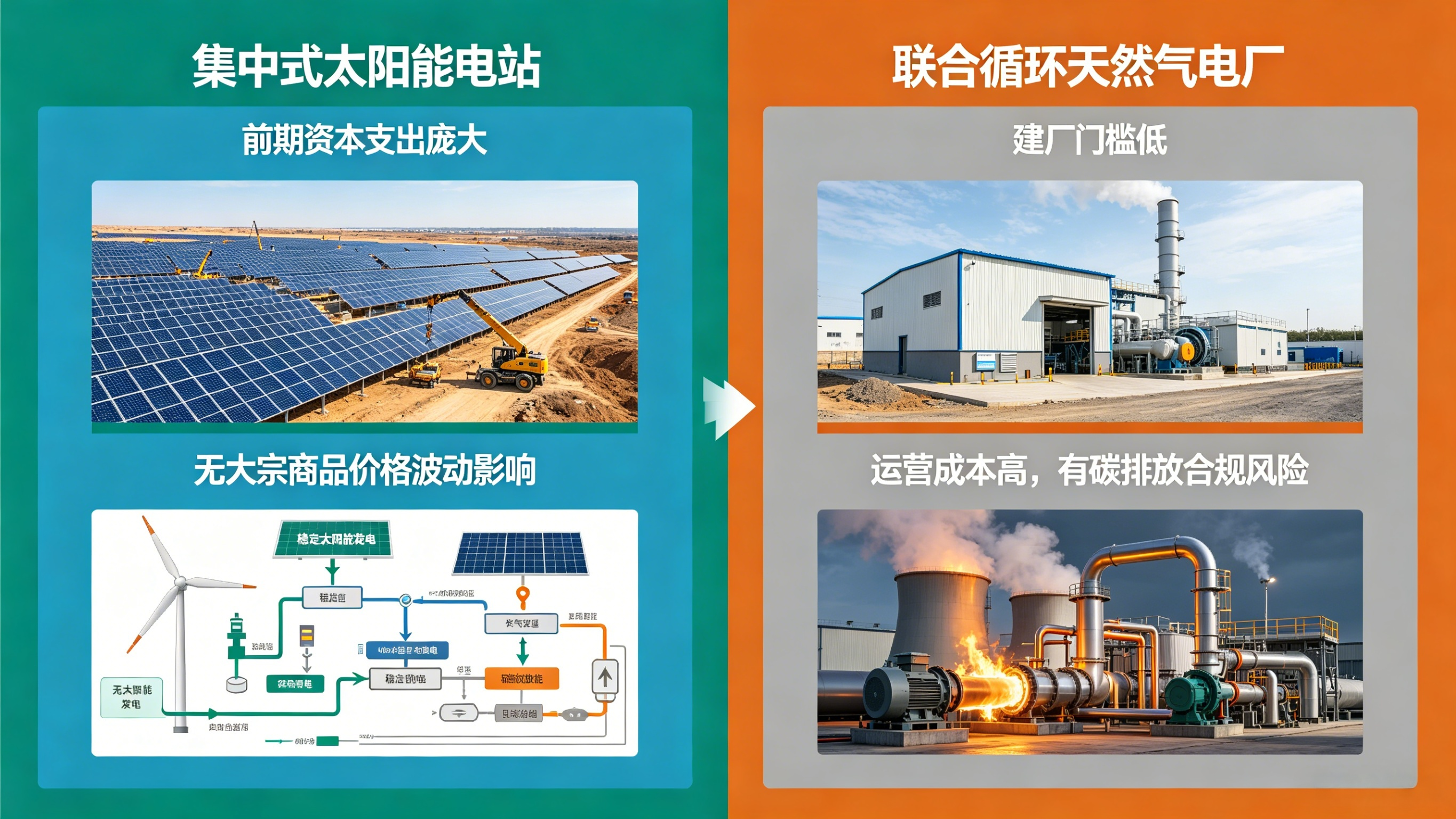
    Centralized Solar Farm: Represents the clean energy transition and aligns with future decarbonization policy trends. It is characterized by massive upfront capital expenditures (CAPEX), but remains unaffected by subsequent commodity price fluctuations.

    Combined Cycle Natural Gas Plant: Represents traditional, stable, and dispatchable baseload power. It features a relatively low construction threshold but is highly dependent on fossil fuels, facing long-term operational expenditure (OPEX) pressures and potential carbon emission compliance risks.

    为了应对日益增长的区域电力需求并优化能源矩阵,某区域性公用事业公司计划新增 100MW 的发电产能。管理层目前面临两条截然不同的技术与财务路径:

    集中式太阳能电站 (Solar Farm): 代表着清洁能源转型,符合未来的脱碳政策趋势。其特点是前期资本支出(CAPEX)庞大,但后续不受大宗商品价格波动的影响。

    联合循环天然气电厂 (Natural Gas Plant): 代表着传统、稳定且可调度的基载电力。其特点是建厂门槛相对较低,但高度依赖化石燃料,面临长期的运营成本(OPEX)压力及潜在的碳排放合规风险。

  • Solar Farm vs. Natural Gas Plant – Economic Comparison

    太阳能电站 vs. 天然气电厂经济比较

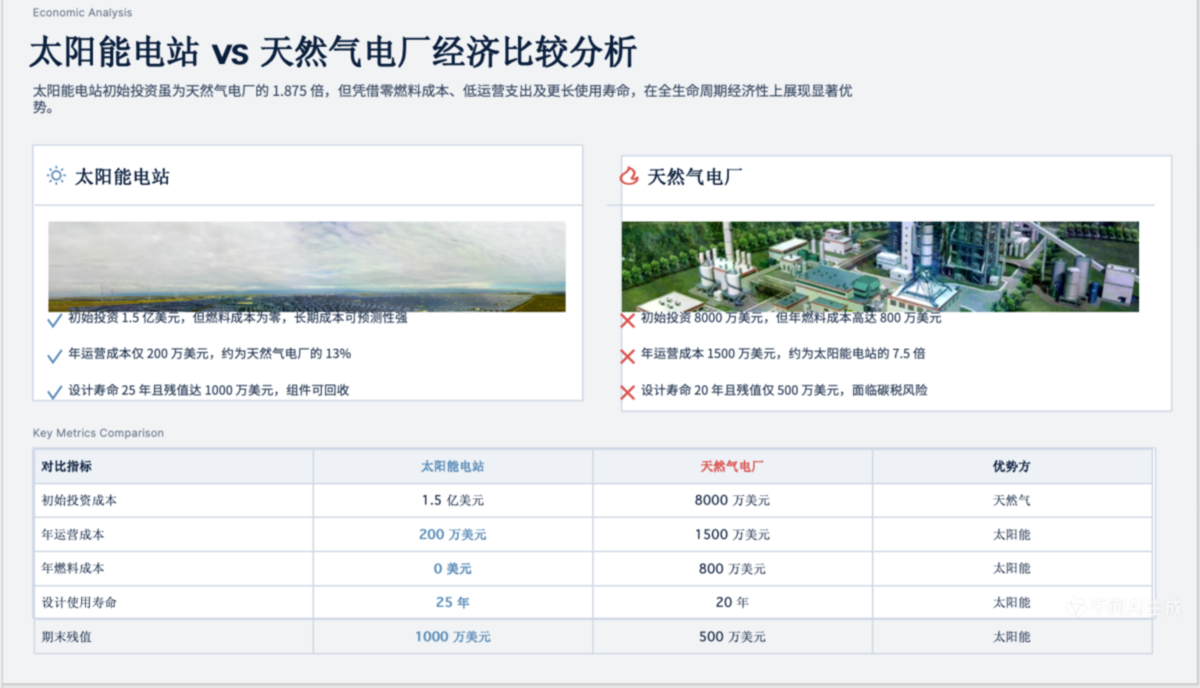
    This case compares the key economic metrics of a typical solar farm and a natural gas plant. The data shows that although the solar farn requires a higher initial investment (150M vs.80M) has aslightly longer payback period(~6.5 years vs. 4.4years), it benefits from zero fuel costs,much lower annual operating costs (2M vs.15M), and a longer lifespan (25 years vs. 20 years). Under an 8% discount rate , the solar farm generates a positive net value (NPV) of approximately 17.2 million , while the natural gas plant yieds a negative NPV of about -7.7 million.

    本案例对比了一座典型太阳能电站与一座天然气电厂的关键经济指标。数据显示,尽管太阳能电站初始投资更高(1.5亿美元vs.0.8亿美元),且投资回报周期略长(约6.5年vs.约4.4年),但其无燃料成本、年运营费用低(200万美元vs.1500万美元),使用寿命更长(25年vs.20年)。在8%的折现率下,太阳能电站的净现值(NPV)为正值(约1720万美元),而天然气电厂的NPV为负值(约-770万美元)

  • Annual Worth Analysis

    太阳能电站 vs天然气电厂年值分析

    The annual worth (AW) method is applied to evaluate the two alternatives with different service lives at an 8% MARR. The equivalent uniform annual cost (EUAC) converts initial investment and salvage value into annual cost, while annual revenue serves as the equivalent uniform annual benefit (EUAB).

    Solar Farm (25-year life):EUAC = 34000(A/P,8%,25) + 400 − 1020(A/F,8%,25) = 3571.83 ten thousand CNY
    EUAB = 2625 ten thousand CNY
    AW = −946.83 ten thousand CNY

    Natural Gas Plant (20-year life):EUAC = 32000(A/P,8%,20) + 1200 + 134400 − 640(A/F,8%,20) = 138846.78 ten thousand CNY
    EUAB = 21000 ten thousand CNY
    AW = −117846.78 ten thousand CNY

    Decision: Although both projects yield negative annual worth, the solar farm presents a far superior economic performance. Therefore, the solar farm is selected.

    本次采用年值法(AW),在基准收益率 8% 的条件下,对两个使用年限不同的方案进行比选。等效年成本(EUAC)将初始投资与残值折算为年度成本,年营业收入作为等效年收益(EUAB)。

    一、光伏电站(使用年限25年)

    等效年成本 = 34000×(资金回收系数,8%,25) + 400 − 1020×(偿债基金系数,8%,25) = 3571.83 万元

    等效年收益 = 2625 万元

    项目年值 = −946.83 万元

    二、天然气电站(使用年限20年)

    等效年成本 = 32000×(资金回收系数,8%,20) + 1200 + 134400 − 640×(偿债基金系数,8%,20) = 138846.78 万元

    等效年收益 = 21000 万元

    项目年值 = −117846.78 万元

    三、分析结论

    计算结果表明,两个方案年值均为负,均无法盈利。但光伏电站亏损远小于天然气电站,全生命周期经济效益更优,因此选择建设光伏电站。

  • 太阳能电站 vs天然气电厂年值分析

    Section image
  • 最终决策结论(Final Decision)

    Final Decision: Recommended Investment Choice

    决策结论:最优投资方案

    Based on the comprehensive techno-economic analysis, lifecycle cost assessment, and risk evaluation of the 100MW power generation project, the centralized solar farm is identified as the superior investment option compared to the combined cycle natural gas plant.

    经过对 100MW 发电项目的全面技术经济分析、全生命周期成本评估与风险研判,集中式太阳能电站被认定为优于联合循环天然气电厂的最优投资方案

    核心决策依据(Core Decision Criteria)

    While the solar farm requires a higher upfront capital expenditure ($150M vs. $80M for the gas plant), its long-term financial performance is significantly stronger:

    Zero fuel costs: Eliminates volatile annual fuel expenses ($8M/year for the gas plant) that erode long-term profitability.

    Lower operating costs: Annual OPEX of $2M vs. $15M for the gas plant, reducing ongoing financial burden.

    Superior financial metrics: At an 8% discount rate, the solar farm delivers a positive NPV of $17.2M, while the gas plant yields a negative NPV of -$7.7M.

    Longer lifespan: 25-year operational life vs. 20 years for the gas plant, extending revenue-generating years.

    尽管太阳能电站前期资本支出更高(1.5 亿美元 vs. 天然气电厂的 0.8 亿美元),但其长期财务表现显著更优:

    零燃料成本:消除天然气电厂每年 800 万美元的燃料支出,避免长期盈利被侵蚀。

    更低运营成本:年运营支出仅 200 万美元,远低于天然气电厂的 1500 万美元,减轻持续财务负担。

    更优财务指标:8% 折现率下,太阳能电站净现值(NPV)为 + 1720 万美元,天然气电厂为 - 770 万美元。

    更长使用寿命:25 年运营周期 vs. 天然气电厂的 20 年,延长收益年限。

    Core Criterion 2: Risk Mitigation & Uncertainty Resilience

    核心依据二:风险缓释与不确定性抵御能力

    The natural gas plant faces two critical risks threatening its long-term viability:

    Commodity price volatility: Exposure to fluctuating natural gas prices, with annual fuel costs accounting for over 50% of lifecycle expenses.

    Carbon compliance risk: Potential carbon taxes or emission regulations could further increase operational costs, worsening the already negative NPV.

    In contrast, the solar farm’s "no commodity dependency" provides a robust hedge against these risks:

    Cash flows are insulated from energy market swings, ensuring predictable long-term costs.

    Alignment with decarbonization policies reduces regulatory and reputational risks, enhancing ESG performance.

    天然气电厂面临两大威胁其长期生存能力的关键风险:

    大宗商品价格波动风险:暴露于不稳定的天然气市场,年度燃料成本占全生命周期支出的 50% 以上。

    碳排放合规风险:潜在碳税或排放法规将进一步推高运营成本,使本已为负的净现值雪上加霜。

    相比之下,太阳能电站 “无大宗商品依赖” 的特性为抵御这些风险提供了强大屏障:

    现金流不受能源市场价格波动影响,确保长期成本可预测。

    与脱碳政策趋势高度契合,降低监管与声誉风险,提升企业 ESG 表现

    Implementation Roadmap & Long-Term Outlook

    实施路径与未来展望

    To maximize the value of the solar farm investment, a phased implementation plan is recommended:

    Phase 1 (0-2 years): Secure financing, permits, and begin construction, leveraging economies of scale to optimize CAPEX.

    Phase 2 (2-5 years): Commission the facility, implement best-in-class O&M practices to maximize performance and minimize downtime.

    Long-Term (5+ years): Integrate battery energy storage systems (BESS) to enhance grid stability, enable dispatchable power, and unlock additional revenue streams.

    This solar farm is not just a power generation asset but a cornerstone of the company’s transition to a low-carbon, resilient energy future.

    为最大化太阳能电站的投资价值,建议采取分阶段实施计划:

    阶段 1(0-2 年):完成融资、审批并启动建设,通过规模效应优化前期资本支出。

    阶段 2(2-5 年):项目投产,实施行业领先的运维实践,最大化发电性能并降低停机时间。

    长期规划(5 年以上):整合电池储能系统(BESS),提升电网稳定性,实现电力可调度性,并拓展额外收入来源。

    该太阳能电站不仅是一项发电资产,更是企业向低碳、韧性能源未来转型的基石

  • 启示

    太阳能发电厂投资分析的深层启示

    Profound Insights from Solar Power Plant Investment Analysis

    一、短期成本陷阱与长期价值的胜利
    I. The Trap of Short-term Costs and the Triumph of Long-term Value

    案例中联合循环天然气电厂看似拥有"低门槛、快回本"的表面优势(4.4年投资回收期vs太阳能的6.5年),但这种优势建立在对长期可变成本的忽视之上。天然气电厂每年800万美元的燃料成本,20年运营周期累计将达到1.6亿美元,远超其8000万美元的初始投资,成为企业背负的"隐形长期负债"。

    The combined-cycle natural gas plant in the case appears to have the superficial advantages of "low entry barriers and quick payback" (4.4-year payback period vs. 6.5 years for solar power), but this advantage is built on neglecting long-term variable costs. The annual fuel cost of $8 million for the natural gas plant will accumulate to $160 million over a 20-year operating cycle, far exceeding its initial investment of $80 million, becoming an "invisible long-term liability" for the enterprise.

    与之相对,太阳能电站的"高额初始投入"本质是**一次性买断未来25年的能源使用权**。零燃料成本的特性使其在投产后几乎不受外部能源市场波动影响,构建了传统能源无法复制的成本护城河。这启示我们:企业决策绝不能被短期现金流和静态回收期绑架,必须建立"全生命周期价值"的评估体系。那些看似"昂贵"的长期主义选择,往往会在时间的复利效应中,最终显现出无可比拟的优势。

    In contrast, the "high initial investment" of a solar power plant is essentially **a one-time purchase of energy usage rights for the next 25 years**. Its zero-fuel-cost characteristic makes it almost immune to fluctuations in the external energy market after commissioning, building a cost moat that traditional energy sources cannot replicate. This teaches us that corporate decisions must never be held hostage by short-term cash flow and static payback periods; instead, a "full lifecycle value" evaluation system must be established. Those seemingly "expensive" long-term choices often ultimately reveal unparalleled advantages through the compounding effect of time.

    二、不确定性的定价:风险才是最大的隐性成本
    II. Pricing Uncertainty: Risk is the Greatest Hidden Cost

    传统财务分析往往只关注可量化的已知成本,却严重低估了不确定性带来的隐性风险。天然气电厂面临着**双重致命不确定性**:一是全球大宗商品价格的剧烈波动,二是日益严格的碳排放合规风险。案例中在8%基准收益率下天然气电厂净现值已为负,若未来引入碳税或天然气价格进一步上涨,其亏损将呈指数级放大。

    Traditional financial analysis often only focuses on quantifiable known costs but severely underestimates the hidden risks brought by uncertainty. Natural gas plants face **two fatal uncertainties**: first, the violent fluctuations in global commodity prices, and second, the increasingly strict carbon emission compliance risks. In the case, the NPV of the natural gas plant is already negative at an 8% benchmark rate of return. If carbon taxes are introduced in the future or natural gas prices rise further, its losses will expand exponentially.

    太阳能电站"无大宗商品依赖"的特性,不仅是成本优势,更是强大的系统性风险对冲工具。在动荡的全球能源市场中,**确定性本身就是最稀缺的价值**。这告诉我们:真正优秀的投资决策,不是追求最高的潜在收益,而是追求在各种极端情况下都能存活的韧性。能够有效隔离外部波动的商业模式,天然拥有更高的内在价值。

    The "no commodity dependence" characteristic of solar power plants is not only a cost advantage but also a powerful systemic risk hedging tool. In a turbulent global energy market, **certainty itself is the scarcest value**. This tells us that truly excellent investment decisions are not about pursuing the highest potential returns but about pursuing resilience that can survive all extreme scenarios. Business models that can effectively isolate external fluctuations inherently possess higher intrinsic value.

    三、政策不是约束,而是价值重估的先行指标
    III. Policy is Not a Constraint, but a Leading Indicator of Value Reassessment

    太阳能电站的经济优势,不仅来自技术进步带来的成本下降,更来自与"全球脱碳"这一不可逆转的时代趋势的深度同频。传统能源的"环境外部性"正在加速内部化,碳排放成本正从"潜在风险"转变为企业必须承担的"刚性支出"。未来随着碳交易市场的完善和碳边境税的实施,两者的价值差距还将进一步拉大。

    The economic advantages of solar power plants come not only from cost reductions driven by technological progress but also from deep alignment with the irreversible global trend of "decarbonization". The "environmental externalities" of traditional energy are accelerating internalization, and carbon emission costs are transforming from "potential risks" into "mandatory expenses" that enterprises must bear. In the future, with the improvement of carbon trading markets and the implementation of carbon border taxes, the value gap between the two will widen further.

    这深刻启示我们:企业战略必须与国家战略和人类共同利益同频共振。那些符合时代发展方向的选择,会获得政策、资本和市场的多重溢价;而逆势而行的决策,即使在短期内看似有利可图,终将付出沉重的时代代价。

    This profoundly teaches us that corporate strategy must resonate with national strategies and the common interests of humanity. Choices that align with the direction of the times will receive multiple premiums from policies, capital, and the market; while decisions that go against the trend, even if they seem profitable in the short term, will ultimately pay a heavy generational price.

    四、能源转型的本质:经济范式的根本重构
    IV. The Essence of Energy Transition: A Fundamental Restructuring of Economic Paradigms

    这场看似简单的技术路线之争,背后是两种截然不同的经济模式的较量。传统化石能源是**资源驱动型经济**:成本随资源价格波动,利润大量被上游资源方攫取,增长受限于有限的资源储量。而新能源是**技术驱动型经济**:成本随技术进步持续下降(过去十年光伏成本下降超过90%),利润由技术创新和精细化管理决定,增长具有几乎无限的潜力。

    Behind this seemingly simple technical route dispute lies a contest between two fundamentally different economic models. Traditional fossil energy is a **resource-driven economy**: costs fluctuate with resource prices, profits are largely captured by upstream resource providers, and growth is limited by finite resource reserves. In contrast, new energy is a **technology-driven economy**: costs continue to decline with technological progress (photovoltaic costs have fallen by more than 90% in the past decade), profits are determined by technological innovation and refined management, and growth has almost unlimited potential.

    案例中太阳能电站更长的设计寿命(25年vs20年)、更高的残值(1000万美元vs500万美元)以及组件可回收的特性,更体现了循环经济的优势。这说明能源转型绝不是简单的"换一种燃料",而是从"消耗资源创造价值"到"利用技术创造价值"的范式革命。谁先掌握了这种新的经济模式,谁就能在未来的全球竞争中占据制高点。

    The longer design life (25 years vs. 20 years), higher salvage value ($10 million vs. $5 million), and recyclable components of solar power plants in the case further demonstrate the advantages of the circular economy. This shows that energy transition is by no means simply "changing a fuel" but a paradigm revolution from "creating value by consuming resources" to "creating value through technology". Whoever masters this new economic model first will occupy the commanding heights in future global competition.

    五、决策的底层逻辑:用终局思维在不完美中选择最优
    V. The Underlying Logic of Decision-Making: Choosing the Best Among Imperfections with Endgame Thinking

    值得注意的是,在当前的计算条件下,两个项目的年值均为负值,这说明纯市场化的能源转型仍面临现实挑战。但太阳能电站的亏损幅度仅为天然气电厂的0.8%,这意味着只要电价小幅上涨、技术进一步进步或政策给予适度支持,太阳能就能率先实现盈利;而天然气电厂则可能陷入"越运营越亏损"的不可逆死循环。

    It is worth noting that under the current calculation conditions, the annual worth of both projects is negative, indicating that purely market-driven energy transition still faces practical challenges. However, the loss magnitude of the solar power plant is only 0.8% of that of the natural gas plant. This means that with a slight increase in electricity prices, further technological progress, or moderate policy support, solar power will be the first to achieve profitability; while natural gas plants may fall into an irreversible vicious cycle of "the more they operate, the more they lose".

    这揭示了一个深刻的决策真理:**优秀的决策者从来不是在"完美选项"中做选择,而是在"不完美的现实"中找到最有韧性、最具成长性的那条路**。用终局思维倒推当下,选择那些即使在最坏情况下也能生存,在最好情况下能获得超额回报的项目,才是穿越周期的制胜之道。

    This reveals a profound truth about decision-making: **Excellent decision-makers never choose among "perfect options" but find the most resilient and growth-oriented path in an "imperfect reality"**. Using endgame thinking to reverse-engineer the present and choosing projects that can survive even in the worst-case scenarios and deliver excess returns in the best-case scenarios is the winning strategy for navigating cycles.